Innovation & Technology
Where eVTOL Is Actually Headed: Three Myths The Certification News Cycle Is Hiding
Joby just flew its first production-conforming aircraft and Archer became the first U.S. eVTOL company to complete Stage 3 of FAA certification - both within the last two weeks. The certification news cycle is real but it's hiding three important misreads about where flying EVs are actually headed. What enterprise leaders should know.
By
Powered EditorialPhotographs
Declan SunCategory
Innovation & TechnologyReading
11 minPublished
May 16, 2026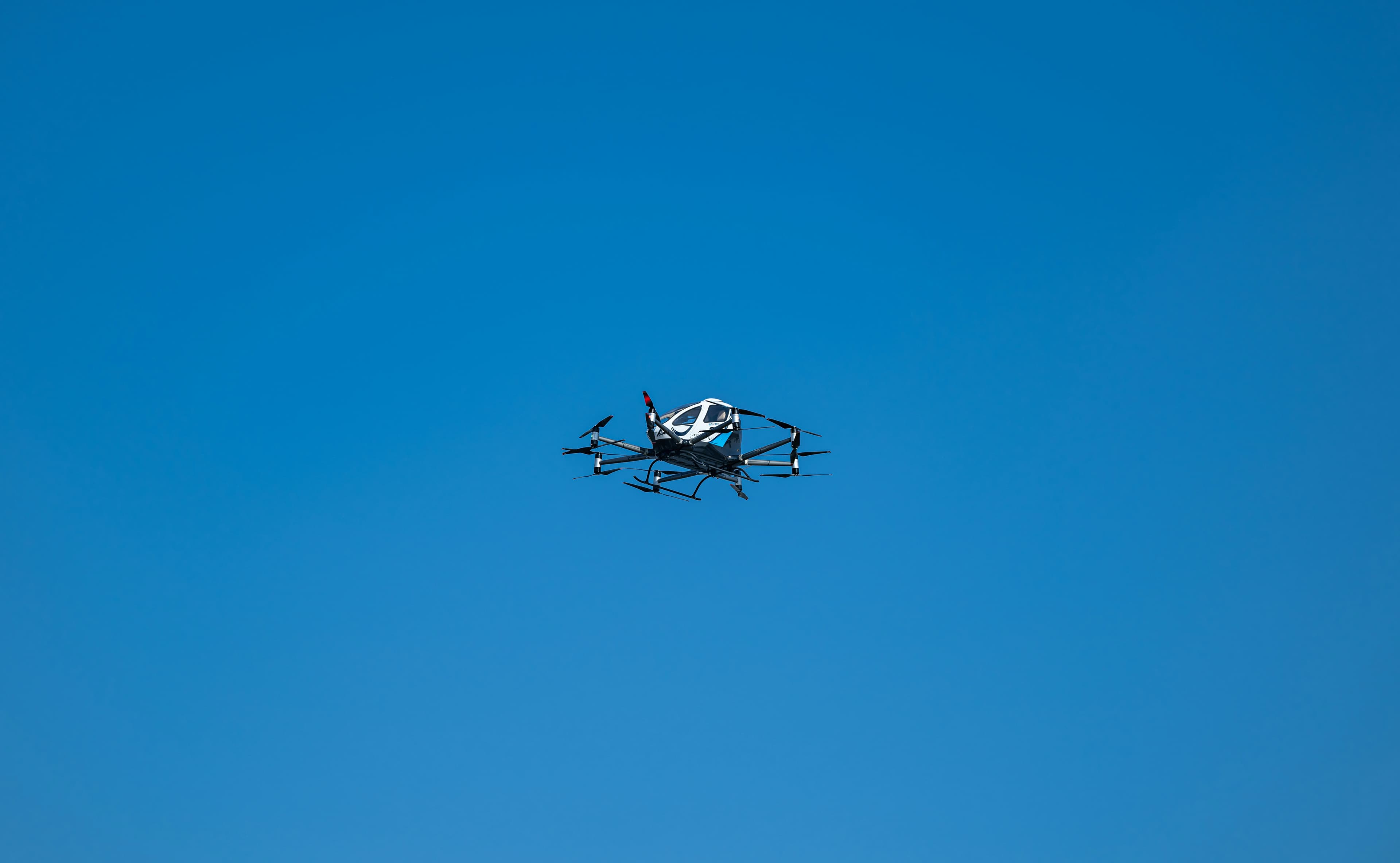
The eVTOL industry has had its most consequential two weeks since the segment became investable. Joby Aviation began flight testing its first production-conforming aircraft (tail number N547JX) at its Marina, California facility — the first U.S. eVTOL manufacturer to advance to Stage 4 of the Federal Aviation Administration's five-stage type certification process. Archer Aviation completed Stage 3 in early May, becoming the first U.S. eVTOL company to reach that milestone. Both companies are positioned to begin U.S. operations this year under the White House's "Future of Flight" initiative. Joby has confirmed Dubai commercial launch in 2026, with Uber integrating the booking flow into its existing app.
For Powered's enterprise reader — and especially for the CTO, COO, or strategy leader watching the eVTOL space as a future logistics, hospitality, or premium-mobility vector — the certification news is the easy story to write about. The harder and more important story is the strategic shape the industry is actually settling into, which looks meaningfully different from how most enterprise observers have been framing it.
Three myths are still circulating in 2026 eVTOL conversations that the actual data is making increasingly untenable.
Myth 1: This is a US story
The FAA certification race between Joby, Archer, and Beta Technologies dominates U.S. coverage and most institutional analyst reports. The implicit assumption underneath this framing is that whichever U.S. company wins Type Certificate first will define the global eVTOL category, with international markets following the U.S. regulatory and commercial template.
The actual unfolding pattern is the opposite. China's EHang has been generating commercial revenue from passenger flights in Guangzhou for over a year — not test flights, not demonstrations, paid passenger operations under Chinese regulatory approval. Dubai's Roads and Transport Authority has signed an exclusive six-year operating agreement with Joby for commercial passenger air taxi service launching in 2026. The first vertiport at Dubai International Airport is scheduled for completion in Q1 2026; the initial vertiport network includes Dubai Mall, Atlantis Royal, and American University. Joby has already completed crewed eVTOL flights between distinct UAE sites and accelerated its Dubai commercial market readiness efforts.
The implication of this geographic sequencing is significant. U.S. eVTOL companies are commercializing internationally first, then bringing the validated operating model back to the U.S. once FAA certification clears. The actual revenue, the actual operational data, and the actual regulatory precedent for passenger eVTOL operations is being generated in Dubai and Guangzhou, not in U.S. metropolitan areas. The companies that fly first in Dubai will set the operating template that other markets — Riyadh, Singapore, São Paulo, Mumbai — will reference when their own regulatory frameworks reach the same point.
This matters strategically because the assumption that the U.S. defines technology categories has been a default in enterprise planning for the last two decades. In eVTOL specifically, that default is incorrect. The U.S. is one of several major commercial markets, behind both China (revenue today) and Dubai (revenue this year). U.S. enterprises planning logistics, premium-mobility, or hospitality integrations should be studying Dubai operations as the leading indicator, not waiting for FAA Type Certification to set the U.S. template.
Myth 2: The race is between Joby and Archer
Inside U.S. coverage, the dominant frame is the Joby-versus-Archer competition. Both companies are public, both have institutional backers (Toyota for Joby, Stellantis for Archer), both are operating in the same regulatory queue, and both have similar passenger-eVTOL product positioning. The analyst framing treats them as the two horse race.
The actual competitive landscape is wider than the binary suggests, and the structural differences between credible eVTOL business models will matter more than the certification finish-line order.
Beta Technologies is pursuing a different commercial path with its ALIA-250 aircraft, including signed contracts with the U.S. military. Beta's eVTOL is designed for cargo and logistics workloads as much as passenger transport, and the company's federal-contracting position gives it a revenue baseline that is meaningfully different from Joby's and Archer's pure passenger-mobility plays.
Electra Aero is not building an eVTOL at all. Its EL9 Ultra Short is a hybrid-electric short takeoff and landing aircraft (eSTOL) that uses blown-lift technology to operate from extremely short runways. Because it takes off and lands conventionally — albeit in compressed footprints — the aircraft fits within the FAA's existing Part 23 small airplane certification framework. That framework is mature, well-understood, and decades old. The FAA does not need to create new standards to evaluate Electra. The certification path is structurally faster than Joby's or Archer's powered-lift path, and the operating economics may be more favorable in regional and mid-haul applications.
Vertical Aerospace (British) and Eve Air Mobility (Brazilian, an Embraer spin-off) are credible international entrants with different cost structures and regional regulatory relationships. EHang is already operating commercially in China. The Joby-versus-Archer frame is the natural retail-investor narrative, but the actual commercial topology of the category in 2030 is going to involve at least six to eight credible operators across passenger, cargo, and military applications.
For enterprise strategists, the practical implication is that vendor selection in eVTOL services — whether the use case is executive transportation, time-sensitive logistics, hospitality, or emergency response — will not collapse to one or two providers. The category will operate more like the regional jet market or the helicopter charter market than like the smartphone market. Multiple vendors, regional differentiation, and use-case-specific specialization. Procurement strategies that assume eVTOL will consolidate around a single winner are setting up for poor vendor terms.
Myth 3: The commercialization timeline will accelerate from here
The third myth is the most common operational assumption inside enterprise organizations watching the space — that with Stage 4 reached by Joby and Stage 3 cleared by Archer, the remaining certification work will compress, and commercial deployment at scale will follow within 18 to 24 months across major U.S. metropolitan markets.
The actual data is more sobering. SMG Consulting, which tracks eVTOL developer progress, revised its forecasts in late 2025 to push entry-into-service projections back by at least six months across the leading developers. Joby's certification fleet accumulated approximately 100 flight hours through early December 2025 — a figure that needs to increase significantly to support the FAA's certification timeline. Joby has now expanded test flying and is targeting roughly four production aircraft per month at its California and Ohio facilities by 2027.
The structural friction sits in three places.
First, the regulatory framework itself is being built in parallel with the aircraft certification. The FAA is developing powered-lift standards while simultaneously evaluating aircraft against them. This is unprecedented in U.S. aviation history and is one of the reasons every developer's timeline has slipped. The 2024 special federal aviation regulation (SFAR) that established training and certification procedures for powered-lift pilots is the foundation; the operating rules, maintenance protocols, vertiport standards, and airspace integration frameworks are still being completed. Each piece of regulatory infrastructure that is not yet finalized becomes a potential delay vector.
Second, the production economics are unproven at scale. Joby's target of four aircraft per month by 2027 is aggressive against the historical baseline for aviation startups producing complex composite airframes with novel electric propulsion systems. The companies that scale production successfully will need to solve manufacturing problems that have not been solved at this geometry before — distributed electric propulsion, large-format aviation-grade batteries, vertical-to-forward-flight transition reliability. None of these is impossible, but each requires extensive in-production validation that has not yet been completed.
Third, the infrastructure deployment problem is severe. Vertiports require megawatt-level charging stations, passenger facilities, maintenance areas, and integration into existing airspace traffic management systems. Dubai is building its initial vertiport network with substantial sovereign investment. U.S. metropolitan markets do not have equivalent unified infrastructure planning. The vertiport deployment in New York, Los Angeles, Miami, and Houston will involve multiple municipal authorities, private real estate operators, FAA airspace coordination, and utility grid upgrades — none of which run on aircraft certification timelines.
For enterprise leaders planning around eVTOL availability, the realistic deployment curve is: limited Dubai service in 2026, expanded Dubai and possibly Singapore/Riyadh service in 2027, U.S. limited operations under the eIPP framework in 2027–2028, and broader U.S. metropolitan deployment in 2029 and beyond. Anyone planning logistics or executive-mobility integrations on a faster timeline is operating against the production-economics and infrastructure data, not just the certification headlines.
Where the category is actually heading
The eVTOL industry is not heading toward a Tesla moment. It is heading toward a regulated utility moment. The companies that understand the difference will own the category.
Tesla disrupted automotive by selling directly to consumers, breaking the dealer-distribution model, and accumulating an operating data advantage that legacy manufacturers could not replicate. The market dynamics that made the Tesla approach work do not apply to eVTOL. Passenger aviation is regulated to a different standard than ground vehicles. Air taxi operations require dispatch infrastructure, pilot training pipelines, maintenance certifications, weather operations protocols, and noise-management agreements with municipal authorities. The companies that succeed at scale will look more like regulated utilities or regional airlines than like consumer-technology disruptors.
This shapes the strategic implications. Joby's vertical integration play — manufacturing its own aircraft, operating its own air-taxi service, controlling charging and dispatch infrastructure — is positioning for the regulated-utility model. Archer's partnership model with Stellantis for manufacturing is positioning for capital-efficient scale within a similar regulatory frame. Beta's federal-contracting position is positioning for the cargo and logistics workloads where the regulatory framework is somewhat more mature. Each of these is a credible bet on how the regulated-utility market will allocate value.
For Powered's enterprise reader, the transferable insight is that the strategic shape of the eVTOL category in 2030 will be defined by regulatory framework and infrastructure deployment, not by aircraft performance specifications. The companies that will matter most are not necessarily the ones with the highest top speed or the longest range. They are the ones with the strongest regulatory relationships, the most operational data from real commercial service, and the most defensible infrastructure positions in their target markets.
Joby's Dubai exclusivity, combined with its first-mover position in U.S. certification, gives it the strongest combination of these advantages today. Archer's Stellantis partnership and capital efficiency give it a credible second position. Beta's federal-contracting moat is a structural advantage in cargo and logistics applications. EHang's existing Chinese commercial operations represent a parallel category that may not directly compete in Western markets but will inform global category economics.
The U.S. certification milestones over the past two weeks are real. They are the necessary regulatory plumbing for a U.S. commercial category that will arrive over the next three to five years. What they are not is the moment when flying EVs become a normalized part of executive mobility. That moment will arrive incrementally, by city, by use case, and by regulatory framework — beginning in Dubai this year and reaching most U.S. metropolitan markets toward the end of the decade.
The enterprises planning seriously around the category are not waiting for FAA Type Certification. They are watching Dubai, modeling vertiport deployment economics, and building procurement relationships with multiple credible operators across passenger, cargo, and specialized use cases. The first-mover advantage in eVTOL adoption will go to the buyers, not the operators. That is the part of the story the certification news cycle is consistently missing.

Nvidia Beat and Rose Nine Percent. The Sector Went Nowhere.
The strongest possible earnings report from the most important company in artificial intelligence lifted its own stock and almost nothing else. Marvell fell more than ten percent the same week on a gross margin forecast. The AI trade has stopped rewarding participation and started interrogating margins.

Brussels Fined Google a Billion, The Compliance Clock Matters More
Brussels fined Google roughly a billion dollars under the Digital Markets Act on 23 July. The money is immaterial to Alphabet. The compliance order behind it is not, and it establishes a template that reaches well beyond the companies formally designated as gatekeepers.

UK Names Cloud Giants "Systemic": What Critical Third Party Status Means
Microsoft, Google Cloud, AWS and Oracle are now supervised entities in the UK financial system. Here's what Critical Third Party designation actually costs, and why enterprise leaders should expect contract and multi-cloud fallout.
Sponsored placement

An invitation, extended to Powered readers.
Drive the Continental GT S.
Private test drives available for Powered readers through Bentley Motors.
