Business News
Freshworks Cut 11% While Revenue Grew 16%. The AI Headcount Math Just Got Real
The Q1 2026 prints from Freshworks and Atlassian are the first hard evidence that the revenue-up, headcount-down trade is structural. Three myths mid-market CEOs need to retire before they plan Q3.
By
Powered EditorialCategory
Business NewsReading
11 minPublished
May 8, 2026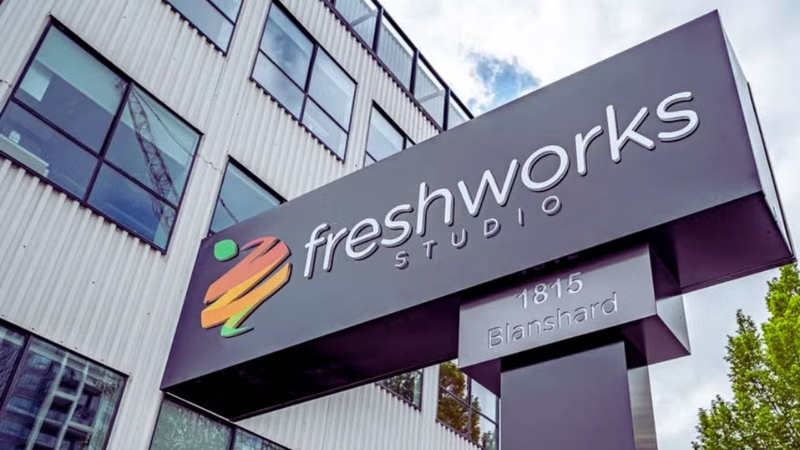
Freshworks announced the week of May 4 that it was cutting roughly 500 employees — 11% of its workforce — at the same time it reported Q1 2026 revenue of $228.6 million, up 16% year-over-year and ahead of estimates.
CEO Dennis Woodside told analysts that more than half of the company's code is now written by AI. Q2 guidance came in at $232–$235 million, also above consensus. Atlassian made a similar cut roughly 10% of its workforce the prior month, citing the same productivity logic.
Layoffs.fyi puts total tech-sector job losses for 2026 at 92,462 as of the first week of May, with the cuts concentrated at companies posting growth, not at companies missing numbers.
The pattern is no longer ambiguous. Revenue is growing. Headcount is shrinking. The savings are being reinvested in the AI products that generated the productivity gains in the first place — Freshworks redirected its cuts into Freshservice, its AI-powered IT service management product, which is now its growth engine. For mid-market CEOs running 100–500-person organizations, the question is not whether this trade applies to their business. It does. The question is which of the assumptions they have been working with about AI and headcount need to be retired before they finalize Q3 hiring plans.
Three myths to dismantle.
Myth 1: AI productivity gains will show up gradually
The dominant mid-market narrative on AI productivity through 2024 and 2025 was that gains would arrive on a slow, predictable curve. CFOs modeled 5–10% productivity uplift over two years, treated the savings as cushion, and left headcount plans largely intact. That model was wrong, and the Freshworks number is the cleanest evidence that the curve is sharper and faster than mid-market planning has assumed.
Woodside's "more than half of the company's code is now written by AI" is the headline number, but the operational story sits underneath it. Freshworks is not laying off engineers because of AI; it is laying off across functions because the company can now generate 16% revenue growth with structurally fewer people. The savings come from merging sales teams, reducing management layers, and automating routine work — exactly the kinds of activities mid-market organizations spend disproportionately on as they scale through the $20M–$200M revenue band.
Gallup's State of the Global Workplace 2026 report adds the institutional read. The report, published April 8, 2026, finds that large employers (10,000+ staff) are most likely to reduce headcount after implementing AI — 33% report reductions — while smaller employers (5,000–10,000) are more likely to expand workforce post-AI implementation, at 38%. Mid-market firms (the 50–500 band Powered's reader sits in) are not surveyed at the same granularity, but the directional pattern is clear: as AI adoption matures inside an organization, the size class above mid-market is cutting headcount, and the size class below mid-market is growing into it.
The implication is that mid-market CEOs face a compressed decision window. The firms running 250 people in mid-2026 will need to decide, by Q3, whether they are heading toward the large-cap pattern (cut to recover margin) or the small-cap pattern (grow into the gap left by enterprise consolidation). The decision cannot be deferred to 2027, because the AI productivity gains have already arrived inside the organizations that compete with the mid-market firm in the same buyer segments. Freshworks is not predicting the future; it is reporting the present.
Myth 2: Layoffs are a sign of weakness
The Atlassian and Freshworks cuts are unusual because the financials do not support the standard layoff-as-distress narrative. Both companies beat revenue estimates. Both raised guidance. Both used the cuts to fund product investment, not to repair balance sheets. The market response, accordingly, was not the share-price punishment that typically follows a 10–11% workforce reduction at a high-growth software company.
This is a meaningful break from the 2022–2023 tech layoff cycle, which was correctly read as a correction from over-hiring during the zero-rate era. The 2026 cuts are different in kind. Freshworks, Atlassian, and the cohort following them are not correcting prior mistakes. They are restructuring around a productivity curve that fundamentally changed what number of people it takes to build and run a software product. The capital markets are reading these cuts as strategic — and the share prices are holding because the market believes the productivity gains are durable.
For mid-market CEOs, the read-across is uncomfortable. The mid-market labor cost structure has been priced against the assumption that organic growth requires headcount growth. That assumption is now contested by the public-company data. A $60M ARR mid-market software firm running 280 people in 2024 should now be asking, with operational seriousness, whether 220 people can deliver the same revenue in 2026 — and whether the 60-person delta is the funding source for the AI-tooling investment that will protect the next two years of growth.
This is not a recommendation to cut. It is a recommendation to model. The Freshworks number means that the mid-market peer group is now actively running this calculation. The firm that does not run it will be competing against firms that have, and the competitive pressure will surface in either margin (the firm holds headcount and absorbs the cost) or growth (the firm is outinvested in AI tooling by a leaner competitor). The data does not say which path is correct for any specific firm. It says the path of "do nothing and hold the headcount plan" is no longer neutral.
Myth 3: The savings will be returned to shareholders
The cleanest mid-market misread of the Freshworks story would be to treat the layoff savings as margin expansion. The company is not running that play. The savings are being redirected into Freshservice — Freshworks' AI-powered IT service management product, which is the growth engine the company is betting will replace the headcount it just removed.
This pattern repeats across the recent tech cuts. Atlassian's reduction was paired with accelerated investment in its AI-native product line. Freshworks' was explicit. The companies cutting headcount are not seeking margin — they are seeking compounding. The savings flow into the products that make the next round of headcount cuts possible.
For mid-market boards, this is the most important framing shift. A layoff that funds AI tooling is not the same financial event as a layoff that funds a buyback or a dividend. The first builds the productivity curve into a competitive moat.
The second returns capital to shareholders and leaves the productivity curve to chance. Mid-market CEOs proposing workforce reductions to their boards in Q3 should be explicit about which path they are running, because the boards that have been reading the public-company data are going to ask the question, and "we'll figure out the reinvestment later" is not the right answer.
The mechanical version of the framework: the productivity gains released by AI tooling are most valuable when they are reinvested in more AI tooling, because the gains compound. The first $1 million of savings funds the second round of automation, which produces the next $2 million of savings, which funds the agentic-AI deployment that produces $5 million the year after. Freshworks' Freshservice investment is on the inside of that compounding curve. A mid-market firm that takes the savings as margin is on the outside.
What this means for Q3 planning
Mid-market CEOs working on Q3 hiring plans should run three exercises before the next board cycle.
The first is a productivity audit on the current headcount. Not a generic "where could AI help us" exercise — a function-by-function review of which roles are net additive in a world where Freshworks is generating 16% growth with structurally fewer people. The audit will surface roles that are still defensible (the ones tied to client relationships, judgment work, and revenue-bearing activity) and roles that are not (most of the middle layer of process management that mid-market firms accumulated through 2022–2024).
The second is a competitive scan. The public-company data — Freshworks, Atlassian, and the broader cohort — is the leading indicator. The lagging indicator is what direct mid-market competitors are doing. CEOs should be asking, with operational seriousness, what their three closest competitors' revenue-per-employee numbers look like, and whether their own number is moving in the same direction. The Freshworks pattern will surface in the mid-market within two to three quarters; the firms that surface it first will define the cost structure the rest have to match.
The third is a reinvestment plan. If the productivity audit suggests headcount can be reduced, the savings need a destination — and the public-company evidence says the destination should be more AI tooling, not margin. Mid-market firms without an AI product roadmap by Q3 will be financing competitors' AI roadmaps in 2027 by ceding deals on price.
The Freshworks number is not an outlier. It is the leading edge of a pattern that has now been confirmed by Atlassian, by the 92,462 layoffs.fyi total, and by Gallup's data on AI-driven workforce reduction at scale. The mid-market firms that read it as such will plan against it.
The ones that read it as a tech-sector story will be reading the wrong report.

Credit Is Loose Right Now, But Not Loose for You
The Federal Reserve chairman told Jackson Hole he would be hard pressed to call financial conditions restrictive, citing tight credit spreads, strong issuance and easier lending standards. In the same remarks he noted that housing and agriculture are showing strain. Both statements are true, and the gap between them is where most small businesses live.

Three Fed Officials Wanted a Hike. The Statement Got Shorter.
The Federal Open Market Committee held rates on 29 July by a nine to three vote, with all three dissenters pushing for an increase rather than a cut. The more consequential change was the statement itself, which is getting shorter on purpose, and what that means for anyone whose planning depended on reading the Fed's intentions in advance.

Record Borrowing, Record Failures: Small Business Runs Out of Defences
The 67 Percent Bankruptcy Spike Has an Eighteen-Month Fuse. Why Small Business Bankruptcies Are Rising Five Times Faster Than Everyone Else's
Sponsored placement

An invitation, extended to Powered readers.
Drive the Continental GT S.
Private test drives available for Powered readers through Bentley Motors.
