Former Cover StoryExclusive · Feature
Four Weeks On, The Royal Pop Tells A Different Story.
Four weeks after the Swatch x Audemars Piguet Royal Pop launched globally on May 16, 2026, the secondary-market trajectory has resolved enough to read. Peak day-one resale averages of $4,400+ for the most hyped colorways have settled to roughly $1,000–$1,500 on WatchCharts and StockX as of early June. Police deployments in Paris, store shutterings in Mumbai and Singapore, and the rapid emergence of third-party bracelet adapters all tell a different story than the launch-day narrative. The original Powered piece argued that the brand-extension playbook underneath the launch was the most interesting thing in luxury watchmaking this year. Four weeks of secondary-market and community data lets us test that thesis.
By
Powered EditorialFiled
New YorkCategory
Business NewsReading
5 minPublished
Jun 9, 2026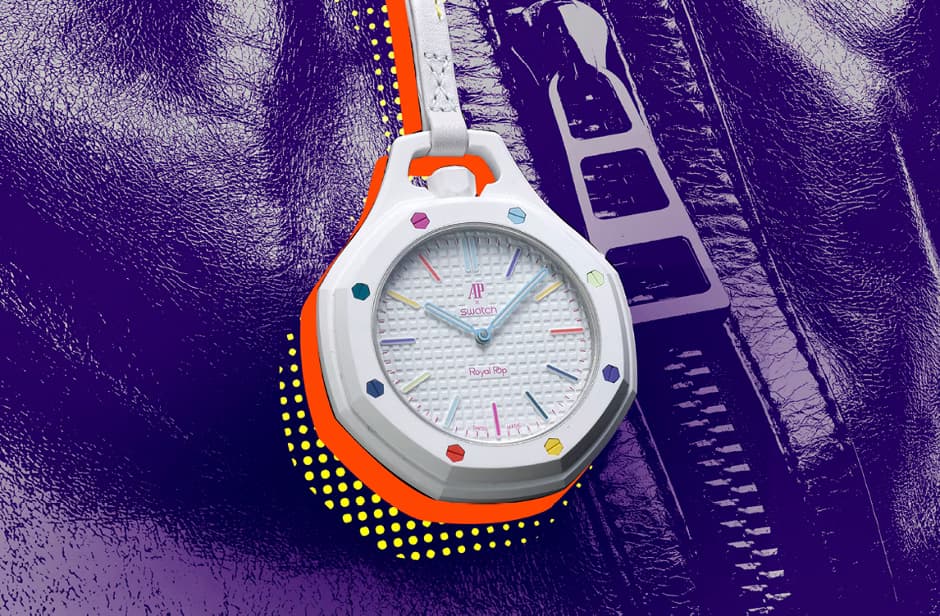
When we covered the Swatch x Audemars Piguet Royal Pop launch on May 16, the argument was that the object itself — the eight Bioceramic pocket watches at $400 — was not the real story. The brand-extension playbook underneath the launch was. Four weeks later, the secondary-market trajectory, the community response, and the operational debris of the launch event have resolved enough to read. The thesis holds in its broad shape. The specifics have surprised the marketing teams who built the launch.
Three angles have resolved in interesting ways since the original piece. Worth working through each.
What the resale market actually did
The launch-day secondary-market story was vertical. StockX cleared more than 1,000 transactions on the Royal Pop collection within hours of launch, with full eight-watch sets averaging $9,476 against a retail value of $3,240 — a 192% premium. The most-chased Lan Ba (blue Savonnette) colorway hit $6,547 on eBay before Swatch paused authorization. Per-piece averages on StockX cleared $1,351, a 222% markup. Hong Kong listings touched $2,820. Singapore platforms posted between $1,350 and $5,550. Esquire UK reported a single eBay listing as high as £15,000.
WatchPro tracked the trajectory through the first 48 hours. Eighteen hours after launch, average prices on eBay and Chrono24 had softened 6–7%. By Monday morning the slide had accelerated. By Day 4, StockX had cleared 1,279 sales total and every single model had dropped between 5.8% and 19.2% from peak. WWD reported the Huit Blanc, which had cleared €2,022 on Sunday, listing closer to $1,295 by midweek. The Lan Ba peaked at €4,310 on Saturday and settled at roughly €1,431 by Tuesday — a 66% slide on a single colorway inside four days.
As of early June, the picture has settled. WatchCharts is showing average market value of roughly $1,000–$1,127 for the most popular SSX03 reference, with the broader collection ranging $800 to $2,000 depending on the model. WatchGuys' inventory is priced in the $1,500–$5,000+ range across colorways. The 4x retail premium that anchored launch-day breathless coverage has compressed to roughly 2.5x–4x depending on the colorway, with the trajectory still pointing downward.
For context, the MoonSwatch (March 2022) traded at significant premiums during launch week and ultimately settled into a stable secondary market at moderate premiums over retail. The Royal Pop trajectory is steeper but directionally consistent. The hyped collaborations clear the same trajectory: extreme launch-day spike, rapid first-week correction, multi-month settlement into a stable but elevated band. Anyone who paid $4,400 for a colorway in the first 24 hours is currently looking at meaningful unrealized losses. Anyone who paid retail and waited four weeks is currently up roughly 150% in resale value. The arbitrage window was approximately 36 hours long. Most retail buyers missed it. Most secondary-market buyers who arrived after Sunday afternoon are now underwater.
The transferable insight for any executive watching this category: hyped Swatch collaborations are now operating as predictable price-discovery events with a 24–48 hour arbitrage window followed by a multi-week correction. The pattern is stable enough to model. The first-mover advantage in the collaboration secondary market goes to whoever can be physically present at a participating boutique on launch morning, which is geographic and logistical rather than analytical.
What the community response actually showed
The community response to Royal Pop split along lines that the launch marketing did not anticipate.
The watch enthusiast press, broadly, has been divided in a way that the original AP fan base typically is not. Gear Patrol's launch coverage included one staff writer's reaction calling the pocket watch decision "an absolute L" and arguing the collaboration should have been a wristwatch even at brand-cheapening cost; another Gear Patrol staffer praised the collaboration as "quirky, fun and disruptive." The split is unusual because the AP-adjacent watch press is normally aligned in either celebrating or savaging a release. The Royal Pop produced legitimate internal disagreement among professional watch writers — meaningfully more than the MoonSwatch did at launch.
The broader enthusiast community on the major watch forums and on Reddit's largest watch subreddits processed the launch through three competing readings. The first reading celebrated the engineering — the hand-wound SISTEM51 with the skeletonized mainspring barrel is genuinely novel at $400, and the technical-enthusiast wing of the community has been straightforwardly positive. The second reading mourned the missed wristwatch opportunity, arguing that the same materials and movement in a wristwatch format would have produced an obvious cultural moment and the pocket-watch format limits both daily wearability and the breadth of the cultural reach. The third reading pushed back on the entire collaboration logic, framing it as a downward extension that risks AP's wristwatch ASP without producing offsetting brand benefit.
The cottage industry that emerged most quickly is worth noting. Within 48 hours of launch, third-party manufacturers and individual makers were producing bracelet adapters, lanyard alternatives, and wristwatch conversion kits to let buyers wear the Royal Pop on the wrist despite the maker's design intent. The conversion market is real, growing, and tells you something important: a meaningful share of buyers acquired the Royal Pop intending to wear it as a wristwatch despite the format Swatch and AP delivered. The market is voting with its accessory purchases that the wristwatch instinct was correct.
What the community response did not produce is the sustained enthusiasm pattern that anchors successful collaborations beyond launch week. The MoonSwatch produced months of organic community content — strap modifications, photography projects, model comparisons, second-purchase decisions. The Royal Pop content cycle has slowed faster than the MoonSwatch's did. The pocket-watch format, by design, produces less daily content because the watch lives in a drawer or on a desk rather than on the wrist where it would be photographed, modified, and shared.
What the operational debris of the launch reveals
The launch event itself had a more chaotic operational footprint than most coverage acknowledged. Police were deployed to manage crowds outside the Paris boutique. Stores in Mumbai and Singapore temporarily closed during launch hours due to safety concerns. The one-watch-per-person-per-day rule was enforced unevenly across regions, with some boutiques reportedly producing crowd-control problems that Swatch's prior launch playbook had not encountered at the same scale.
The Hong Kong and Singapore secondary-market pricing — meaningfully higher than U.S. and European averages on launch day — reflects regional supply constraints that Swatch did not pre-position for. The boutique network in Asia was undersized for the launch demand, producing the geographic arbitrage that drove the highest peak prices. The European supply was sufficient to absorb most launch-day demand; the Asian supply was not. By Day 4, the geographic price spread had narrowed as supply equalized, but the regional dynamic was the genuine operational story underneath the secondary-market chaos.
The Royal Pop also produced something Swatch's collaborations have not produced before: meaningful negative-PR exposure for AP specifically. The Paris police deployment and the Mumbai store shuttering became their own news cycle, and the reputational tail belongs more to AP than to Swatch — AP is the prestige partner whose brand equity was attached to the launch theater, and AP's existing collector base is the audience least comfortable with mall-boutique queue chaos as part of the brand experience.
What the four-week trajectory means for the original thesis
The May 16 piece argued that the Royal Pop was the most strategically interesting downward brand extension in luxury watchmaking this year — and that the more interesting question, six months out, would be whether AP's wristwatch sales continued to grow alongside the Royal Pop's success.
Four weeks of data does not answer the six-month question. It does, however, produce three observations that adjust the trajectory of the answer.
The visibility lift for AP was real and meaningful during launch week. The brand was the most-discussed name in luxury watches across both enthusiast and general-interest media for approximately five days. Whether that visibility translates into incremental wristwatch sales depends on whether the discussion produced consideration among buyers who would not previously have considered the brand. The secondary-market chaos and the police deployments did not produce the kind of discussion that builds wristwatch consideration. They produced spectacle, which is a different consumer-psychology outcome.
The collector-base reaction within AP's existing audience appears mixed at best. The proceeds-to-craft-preservation framing did meaningful work to defend the collaboration to the existing collector base — without that structural commitment, the negative-PR exposure would have been worse. But the bracelet-adapter cottage industry and the pocket-watch format frustration suggest the collaboration has not produced the cleanly positive reception inside the existing community that the brand strategy required.
The four-week trajectory has compressed the upside case. The launch made AP the most-talked-about brand in luxury watches for a week. The four-week trajectory will tell you whether that visibility translates into the wristwatch buyers the Royal Pop was actually marketing to. The answer is not yet clear. The early signal is more cautious than the launch coverage implied. AP's H2 2026 wristwatch sales data, when it surfaces, will be the most-watched number in the category.
For Powered's reader watching brand-extension strategy at the portfolio level, the Royal Pop is now a case study with sharper edges than it had four weeks ago. The downward brand extension at this magnitude — 75x price reduction from the wristwatch flagship to the collaboration product — produces visibility, secondary-market chaos, and a polarized community response. Whether it produces durable brand equity transfer is the question the next two quarters will settle. The McLaren Golf launch from late April, by comparison, has had a quieter post-launch trajectory — the upward brand extension produced less spectacle and less measurable reaction. Two directions of travel; two very different post-launch profiles.
Most brand extensions are quiet for a reason. The Royal Pop chose loud. Loud produced a week of attention and four weeks of secondary-market correction. Six months from now, the question will be whether the attention converted to anything that lasts.

Credit Is Loose Right Now, But Not Loose for You
The Federal Reserve chairman told Jackson Hole he would be hard pressed to call financial conditions restrictive, citing tight credit spreads, strong issuance and easier lending standards. In the same remarks he noted that housing and agriculture are showing strain. Both statements are true, and the gap between them is where most small businesses live.

Three Fed Officials Wanted a Hike. The Statement Got Shorter.
The Federal Open Market Committee held rates on 29 July by a nine to three vote, with all three dissenters pushing for an increase rather than a cut. The more consequential change was the statement itself, which is getting shorter on purpose, and what that means for anyone whose planning depended on reading the Fed's intentions in advance.

Record Borrowing, Record Failures: Small Business Runs Out of Defences
The 67 Percent Bankruptcy Spike Has an Eighteen-Month Fuse. Why Small Business Bankruptcies Are Rising Five Times Faster Than Everyone Else's
Sponsored placement

An invitation, extended to Powered readers.
Drive the Continental GT S.
Private test drives available for Powered readers through Bentley Motors.
