Lifestyle
Audemars Piguet Just Made A $400 Pocket Watch. The Real Story Isn't The Object.
Swatch and Audemars Piguet launched the Royal Pop collection today — eight Bioceramic pocket watches at $400, the first time AP has ever licensed the Royal Oak silhouette outside its factory. The object is unusual. The brand-extension playbook underneath it is the most interesting thing in luxury watchmaking this year.
By
Powered EditorialPhotographs
Audemars PiguetFiled
New YorkCategory
LifestyleReading
6 minPublished
May 16, 2026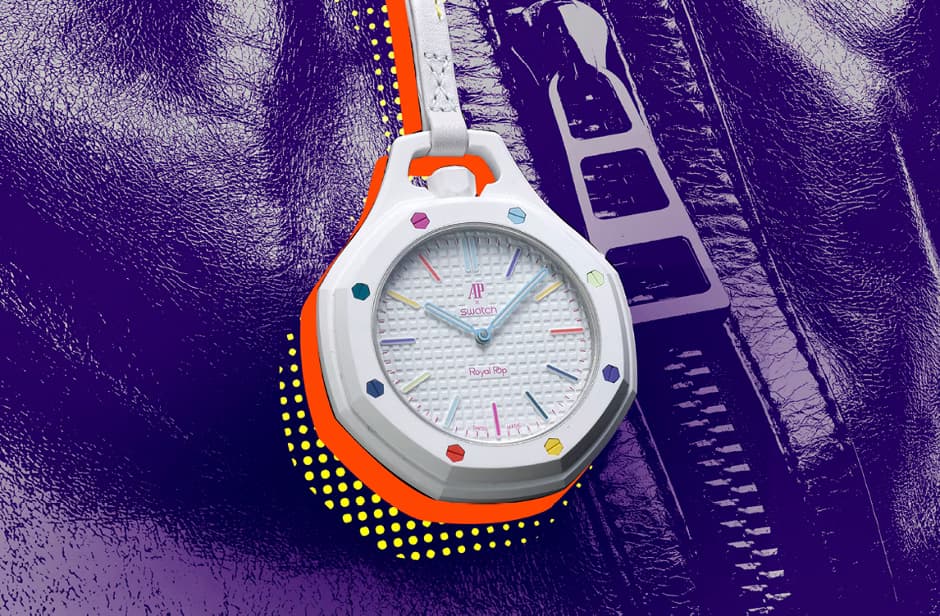
The Swatch x Audemars Piguet "Royal Pop" collection went on sale this morning at selected Swatch boutiques worldwide. Eight Bioceramic pocket watches in two case styles — six Lépine (open-face) at $400 and two Savonnette (hinged-cover) at $420. The launch follows the now-familiar Swatch playbook: full-page abstract teaser ads in The Guardian, an Instagram reveal, a product unveiling four days before drop, in-store only, one watch per person per day, with queues already factored into store planning. Swatch CEO Nick Hayek has publicly referenced the MoonSwatch's 5,000-strong Australian queue as a baseline for what to expect.
Two things make this launch genuinely unusual, separately from the object itself.
The first is that Audemars Piguet has licensed the Royal Oak silhouette to an external manufacturer for the first time in the design's 54-year history. AP has done collaborations before — Travis Scott, Marvel, John Mayer — but every one of those projects stayed inside AP's own factory, made on AP's own equipment, sold at AP prices. The Royal Oak walking out the front door of Le Brassus and into a Swatch boutique is the kind of decision that would have been internally unthinkable a decade ago. The fact that AP is now on board signals a clear-eyed reassessment of what downward brand extension can produce for a maison whose wristwatches start at $30,000.
The second is the form factor. Almost everyone watching the teaser cycle assumed Royal Pop would be a Bioceramic wristwatch — a MoonSwatch-style accessible take on the Royal Oak's octagonal bezel and integrated bracelet. Instead, Swatch and AP skipped the wrist entirely. The Royal Pop is a pocket watch. It clips to a lanyard, sits on a desk stand, hangs from a bag. It is the first major mechanical pocket watch launch from a serious haute horlogerie partnership in a generation.
For the executive reader who pays attention to watches — or to brand strategy more broadly — three angles are worth thinking through.
What's actually unique
The technical answer is the new hand-wound SISTEM51. Swatch's original SISTEM51, launched in 2013, was a fully machine-assembled automatic movement with 51 parts — an engineering achievement that brought mechanical watchmaking down to accessible price points. For the Royal Pop, Swatch reengineered the caliber as a hand-wound movement with 15 active patents covering the new build. The balance spring is Nivachron, an anti-magnetic alloy that Swatch Group and Audemars Piguet jointly developed in 2018. The balance itself is free-sprung and laser-tuned at the factory for accuracy of -5 to +15 seconds per day. Power reserve is 90 hours.
The most visually distinctive feature is the skeletonized mainspring barrel. Swatch cut a circular opening into the barrel so the coiled mainspring sits in plain view through the caseback. A freshly wound watch shows a tight gold coil filling the window. As the watch runs and the spring releases its tension, grey starts showing through the gaps — a literal visual indicator that it's time to wind. This is a piece of mechanical theater that gets at what the collaboration is actually trying to do: make the mechanical movement legible to a generation that has not grown up with mechanical watches.
The second unique element is the AP heritage choice. AP's design source for the Royal Pop case is the Royal Oak Pocket Watch reference 5691, not the wristwatch. This is a careful decision. It lets the collaboration draw on legitimate AP heritage — the maison has produced Royal Oak pocket watches before, in extremely limited quantities — without producing a Bioceramic copy of the wristwatch that starts at $30,000 retail. The Bioceramic case is 40mm across and 8.4mm thick, with the Royal Oak's octagonal bezel, vertical satin finishing on the bezel and case back, and eight hexagonal screws. The dial carries the Royal Oak's signature Petite Tapisserie pattern. Both hands and indices use Grade A Super-LumiNova.
The eight colorways are each named in a different language for the number eight — Otto Rosso (Italian), Huit Blanc (French), Green Eight (English), Blaue Acht (German), Orenji Hachi (Japanese), Lan Ba (Chinese), Ocho Negro (Spanish), OTG Roz (Hungarian/Polish riffs). The naming nods to the eight visible screws of the Royal Oak bezel. On the white Huit Blanc model, those screws arrive in eight different colors.
The third unique element is the proceeds arrangement. Audemars Piguet has committed 100% of its share of Royal Pop revenue to a dedicated initiative supporting the preservation and transmission of watchmaking savoir-faire, with a focus on rare crafts and developing next-generation horological talent. For a family-owned independent maison that has traded on craftsmanship for 150 years, the philanthropic structure is consistent with the brand position. It also makes the collaboration easier to defend to AP's existing collector base, for whom the prospect of a $400 Royal Oak silhouette landing in mall boutiques is not an obviously appealing development.
What's familiar
The launch playbook is the most carefully reproduced playbook in modern watch marketing. The MoonSwatch (Omega x Swatch, March 2022) established the template — full-page newspaper teasers, no-logo countdown ads, an Instagram confirmation, a product reveal a few days before drop, in-store only, one per person per day, queues outside boutiques. The Scuba Fifty Fathoms (Blancpain x Swatch, September 2023) reproduced the template. The Royal Pop reproduces it again. Swatch has moved over two million MoonSwatch units across 36 models since the original launch. The playbook is operationally proven and commercially serious — this is not a cultural marketing exercise, it is a distribution strategy that has produced sustained category-leading revenue for Swatch Group.
The downward-brand-extension move from haute horlogerie is also less novel than the AP framing suggests. Patek Philippe quietly distributes some Calatrava entry models below the $20,000 line. Vacheron Constantin's Patrimony collection extends well below the maison's flagship pricing. What distinguishes Royal Pop is the magnitude of the price drop — from $30,000+ wristwatch to $400 pocket watch is a ~75x reduction — and the public theater around it. Most haute horlogerie downward extension is quiet. Swatch x AP is loud.
The pocket-watch decision is also less surprising than it first appears in the context of broader luxury merchandising trends. Pocket watches were the original mechanical watch format; their disappearance from contemporary wear was a 20th-century accident driven by wristwatch convenience in mechanized warfare and industrial settings. The pocket watch as accessory — clipped to a lanyard, sitting on a desk, hanging from a bag — is a form factor that fits 2026 wearable-tech-adjacent aesthetics more naturally than the wristwatch format does. Swatch and AP are not reinventing a category. They are returning to one.
Should you join the queue
Honest read.
If you are a watch collector who already owns mechanical pieces and you appreciate the engineering and brand-extension story, the Royal Pop is a meaningful acquisition. The hand-wound SISTEM51 with skeletonized barrel is a genuinely novel movement at this price point. The first external Royal Oak silhouette in 54 years has provenance significance that will hold over time, regardless of whether the secondary-market value appreciates. For this buyer, the queue is worth it.
If you have been watching the MoonSwatch and Scuba Fifty Fathoms drops with mild interest but have not committed, Royal Pop is the most thematically ambitious entry in the series and the most likely to age well as a cultural artifact. The pocket watch form factor will divide buyers — some will love it as an accessory, others will find it impractical compared to a wristwatch. The form factor question matters more than the price.
If you are buying primarily as a status object or conversation piece, the Royal Pop will do that work, but you should know the Royal Oak wristwatch is not what you are buying. The collaboration is, by design, a different object than the AP Royal Oak — different category, different price tier, different intended audience. Some of the AP collector community will dismiss Royal Pop owners as MoonSwatch-tier rather than Royal Oak-tier. The badge does carry. The cachet, less so.
The genuinely undifferentiated answer: the Royal Pop is a thoughtful piece of accessible mechanical watchmaking at $400, with a brand-extension story that is genuinely unique. It is not a Royal Oak. It is a pocket watch with serious AP design DNA, made by Swatch, with proceeds supporting watchmaking craft. If that combination interests you, get to a boutique. If it doesn't, the existing AP Royal Oak Selfwinding at $30,000+ remains the object the Royal Pop's marketing is gesturing toward.
What this tells you about brand-extension strategy
If McLaren's golf launch two weeks ago was the most operationally serious upward brand extension of 2026 — luxury automotive engineering legitimately entering premium golf — Royal Pop is the most strategically interesting downward brand extension. Two directions of travel, same underlying question for the parent brand: how much brand equity can be transferred across categories or price tiers without eroding the position the equity originally protected.
McLaren bet that engineering credibility transfers across categories. Audemars Piguet has bet that the Royal Oak design language carries enough cultural weight to survive a 75x price reduction while remaining recognizably AP. Both bets will be measured in their secondary effects two and three years out — McLaren's golf revenue, AP's wristwatch ASP, the broader category response from competitors who watch how these moves play.
For the boards and executives watching luxury brand strategy from adjacent industries, the data points are accumulating. Porsche Design's depth, McLaren's golf entry, Royal Pop, the parallel moves Ferrari, Lamborghini, and Aston Martin are working on. The brands that succeed at extension are the ones that commit operational depth alongside marketing theater. The brands that fail are the ones that license a logo and call it a strategy.
The Royal Pop is on sale today. The queues will be long. And six months from now, the more interesting question will not be whether Swatch sold out the run — they will — but whether AP's wristwatch sales continue to grow alongside the Royal Pop's success. That answer is the one the rest of the luxury watch industry will be reading.
"Audemars Piguet has spent 54 years protecting the Royal Oak inside Le Brassus. The Royal Pop is the first time the design language has been allowed to walk out the front door."

Absolut's Owner Just Posted a Third Straight Annual Decline
Pernod Ricard's US sales fell 14 percent and its Chinese sales fell 19 percent in the year to June. The company's ready-to-drink category grew 12 percent, driven by younger drinkers. The gap between those numbers is a strategy problem, and it is not the one the industry has been discussing.

Wall Street's Tailors Are Overbooked. Retail Should Be Worried.
New York's bespoke tailors are taking in suits at a ratio they have never recorded, and hiring staff to keep up. The same shift that filled their order books has left the wider apparel industry holding several hundred million units of inventory built against a size curve that no longer describes the customer.

Premium Travel Is Sold on Scarcity. The Pipeline Just Hit a Record.
Two Speeds: Delta's Premium Cabin Just Overtook Its Main Cabin for the First Time. Quiet Luxury Is Priced on the Absence of Other People. Everyone Is Selling the Same Absence.
Sponsored placement

An invitation, extended to Powered readers.
Drive the Continental GT S.
Private test drives available for Powered readers through Bentley Motors.
