Business News
The "Return to Office" War Is Over. Both Sides Lost.
Hybrid work has quietly become the default, and neither remote-work advocates nor office hardliners got what they wanted. The data shows why the compromise pleasing no one may be the arrangement everyone is stuck with.
By
Staff WriterCategory
Business NewsReading
2 minPublished
Apr 14, 2026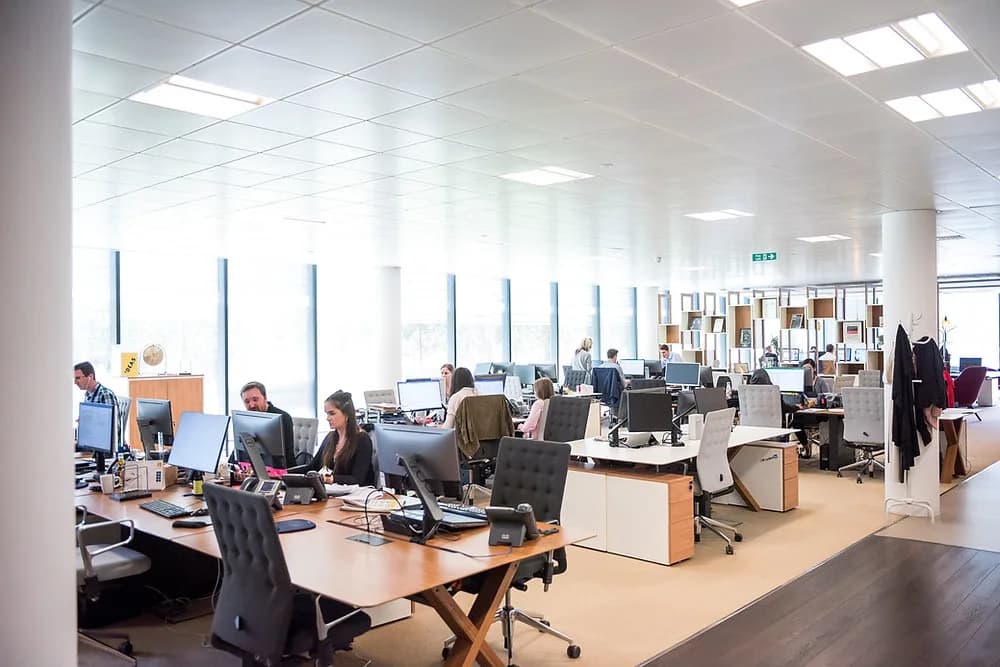
The fully-remote evangelists predicted that offices would become obsolete, that companies would embrace distributed work permanently, and that the old model of commuting to a cubicle five days a week would be relegated to history. The fully-in-office traditionalists predicted that the remote work experiment would be exposed as a productivity killer, that culture and collaboration required physical presence, and that everyone would eventually come back because that's how real work gets done.
Neither prediction came true. What happened instead is a messy, inconsistent hybrid that has somehow managed to deliver the worst aspects of both models while capturing the full benefits of neither.
The typical hybrid arrangement in 2026 looks something like this: employees are expected in the office two or three days a week, with the specific days varying by team, function, or managerial preference. On in-office days, they commute to an open-plan space where they spend most of their time on video calls with colleagues who chose a different day to come in. On remote days, they work from home while trying to coordinate with the people who are in the office, using tools that were designed for one or the other but not both.
The coordination costs alone are staggering. Managers spend hours trying to align schedules. Teams that were promised flexible work arrangements find that the flexibility is theoretical, because if the meetings they need to attend are on Tuesday and Thursday, then Tuesday and Thursday are their office days whether they like it or not. And the real estate costs haven't decreased by nearly as much as companies hoped, because the office still needs to be large enough to accommodate everyone on the busiest days, even though it sits half-empty on the slowest ones.
The companies that are actually making hybrid work aren't treating it as a compromise between remote and in-person. They're treating it as a distinct operating model with its own practices, norms, and infrastructure. They're designating specific purposes for in-person time (collaboration, team-building, creative work sessions) and specific purposes for remote time (focused individual work, heads-down production). They're investing in technology that actually works for hybrid meetings rather than making remote participants stare at the back of people's heads in a conference room.
The takeaway isn't that hybrid work doesn't work. It's that lazy hybrid, the kind that's just a calendar split between home and office without any thought about what makes each setting valuable, doesn't work. The model needs to be designed, not defaulted into. And the companies that figure out the design question will have a meaningful talent advantage for years to come.

Credit Is Loose Right Now, But Not Loose for You
The Federal Reserve chairman told Jackson Hole he would be hard pressed to call financial conditions restrictive, citing tight credit spreads, strong issuance and easier lending standards. In the same remarks he noted that housing and agriculture are showing strain. Both statements are true, and the gap between them is where most small businesses live.

Three Fed Officials Wanted a Hike. The Statement Got Shorter.
The Federal Open Market Committee held rates on 29 July by a nine to three vote, with all three dissenters pushing for an increase rather than a cut. The more consequential change was the statement itself, which is getting shorter on purpose, and what that means for anyone whose planning depended on reading the Fed's intentions in advance.

Record Borrowing, Record Failures: Small Business Runs Out of Defences
The 67 Percent Bankruptcy Spike Has an Eighteen-Month Fuse. Why Small Business Bankruptcies Are Rising Five Times Faster Than Everyone Else's
Sponsored placement

An invitation, extended to Powered readers.
Drive the Continental GT S.
Private test drives available for Powered readers through Bentley Motors.
